 In honor of Asian American & Pacific Islander (AAPI) Heritage Month, the Museum is pleased to highlight a number artists who have lived an artful life, creating work that pays homage to their ancestry. Opening May 16, the works can be seen in Just Powers: Long Island Biennial 2026
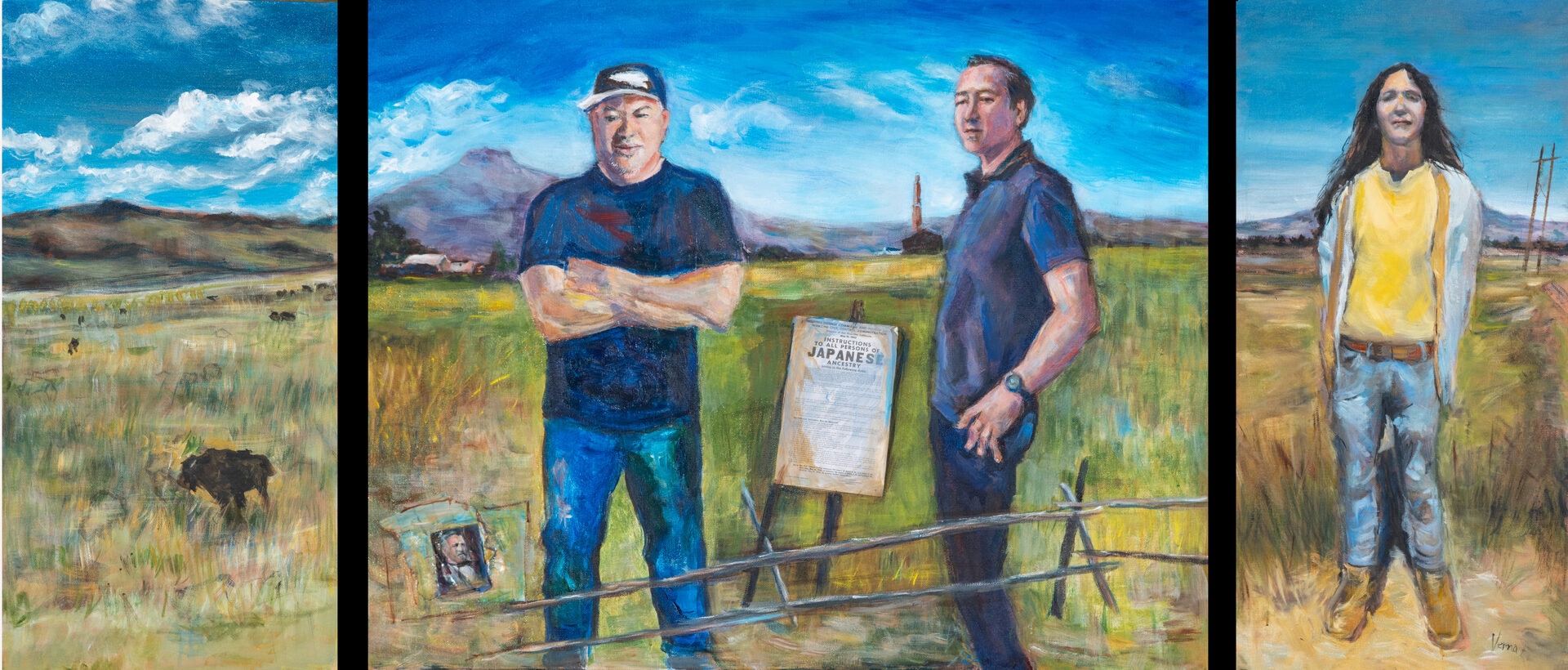
Verna Lynn Amakawa’s (Huntington) work, Buffalo Heart Mountain, speaks to the history of incarceration of Japanese Americans during WWII, and its impact on indigenous peoples. Wan Ling Fahrer (Saint James) references migration and resilience as part of her family’s migration from Hong Kong to the U.S., in New Beginnings. Inspired by her grandmother’s memories, Joan Kim Suzuki reflects on Korea’s liberation from Japanese colonial rule at the end of World War II in Independence Day.
Read the moving Artist Statements below.
Guests visiting the Museum should linger at artwork of these additional AAPI artists in the exhibition: Pinky Urmaza, Hui Tian, Benjamin Truong, and William Low.
Verna Lynn Amakawa (Huntington) Buffalo Heart Mountain, 2026, acrylic with collage.
Artist Statement: In March 1875, President Grant issued an executive order canceling a previous order that had reserved land in the Montana Territory for the Crow Nation (Apsáalooke), who were forced to cede much of their ancestral lands to the U.S. government over the 19th and 20th centuries. In February 1942, President Roosevelt issued an executive order for the forced removal and incarceration of all Japanese Americans living on the West Coast. Formerly a sacred site for the Crow, Buffalo Heart Mountain, near Cody, Wyoming, became the location of the Heart Mountain Relocation Center, one of ten major confinement camps that incarcerated over 120,000 Japanese Americans between 1942 and 1946. The three painted figures participated in the dedication of the Mineta-Simpson Institute at the Heart Mountain Wyoming Foundation commemorating the friendship of Republican Senator Alan Simpson and Democratic Cabinet Secretary Norman Mineta, who met in 1943 as Boy Scouts at the Heart Mountain World War II Japanese American Confinement Site. This triptych is a tribute to the First Nation peoples and Japanese Americans who suffered loss of home and livelihood.
Wan Ling Fahrer (Saint James} New Beginnings, 2026, Digital composite photo.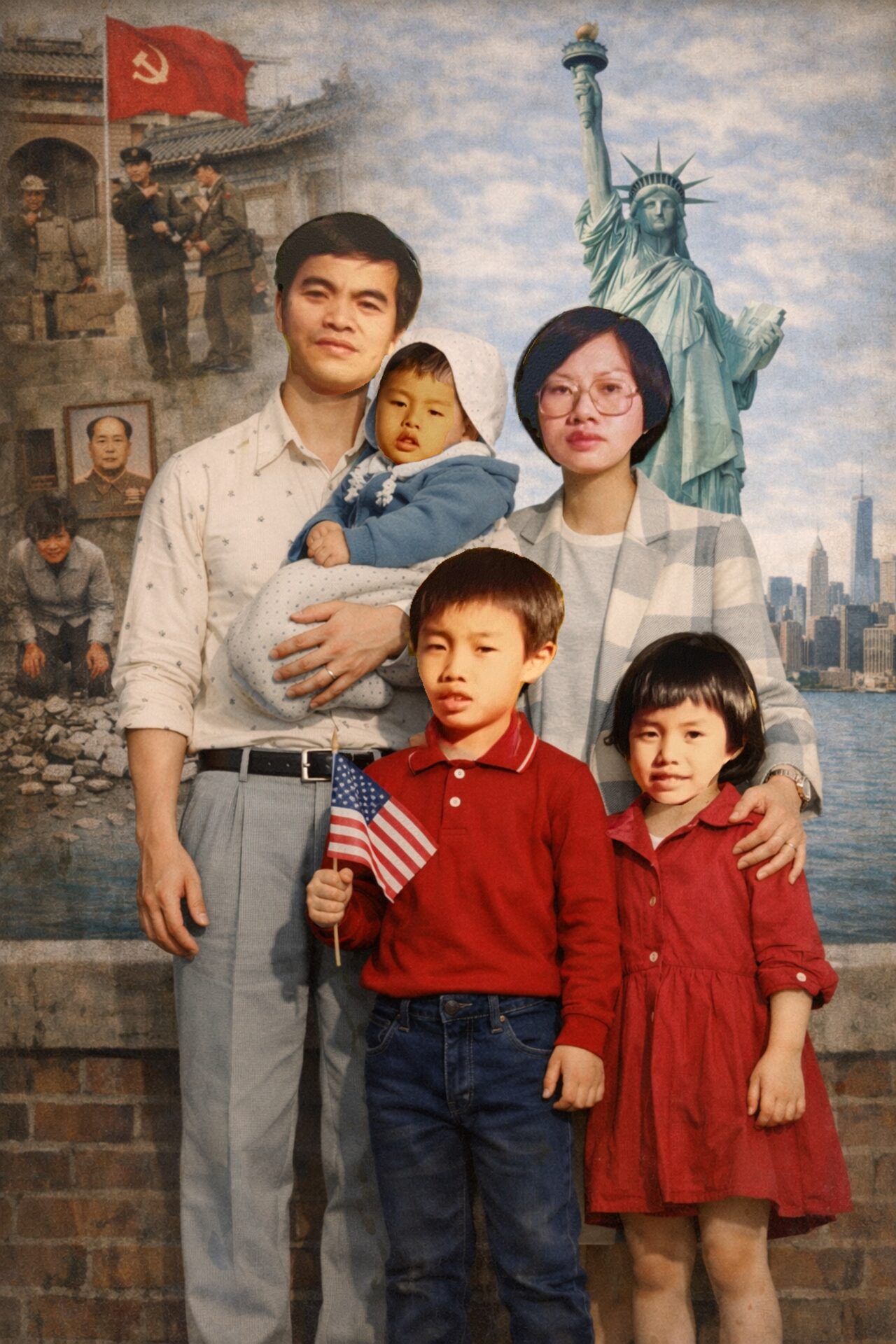
Artist Statement: The conceptual foundations of Wan Ling Fahrer’s work emerge from lived experiences shaped by migration, instability, and resilience. The artist’s family legally immigrated from Kowloon, Hong Kong to the United States when she was two, seeking safety from the political uncertainty preceding the 1997 transfer of sovereignty. Prior to that, Fahrer’s mother experienced the Cultural Revolution in China as a child. Her earliest memories were seeing her grandmother tortured by crawling on glass and their ancestral home confiscated to turn 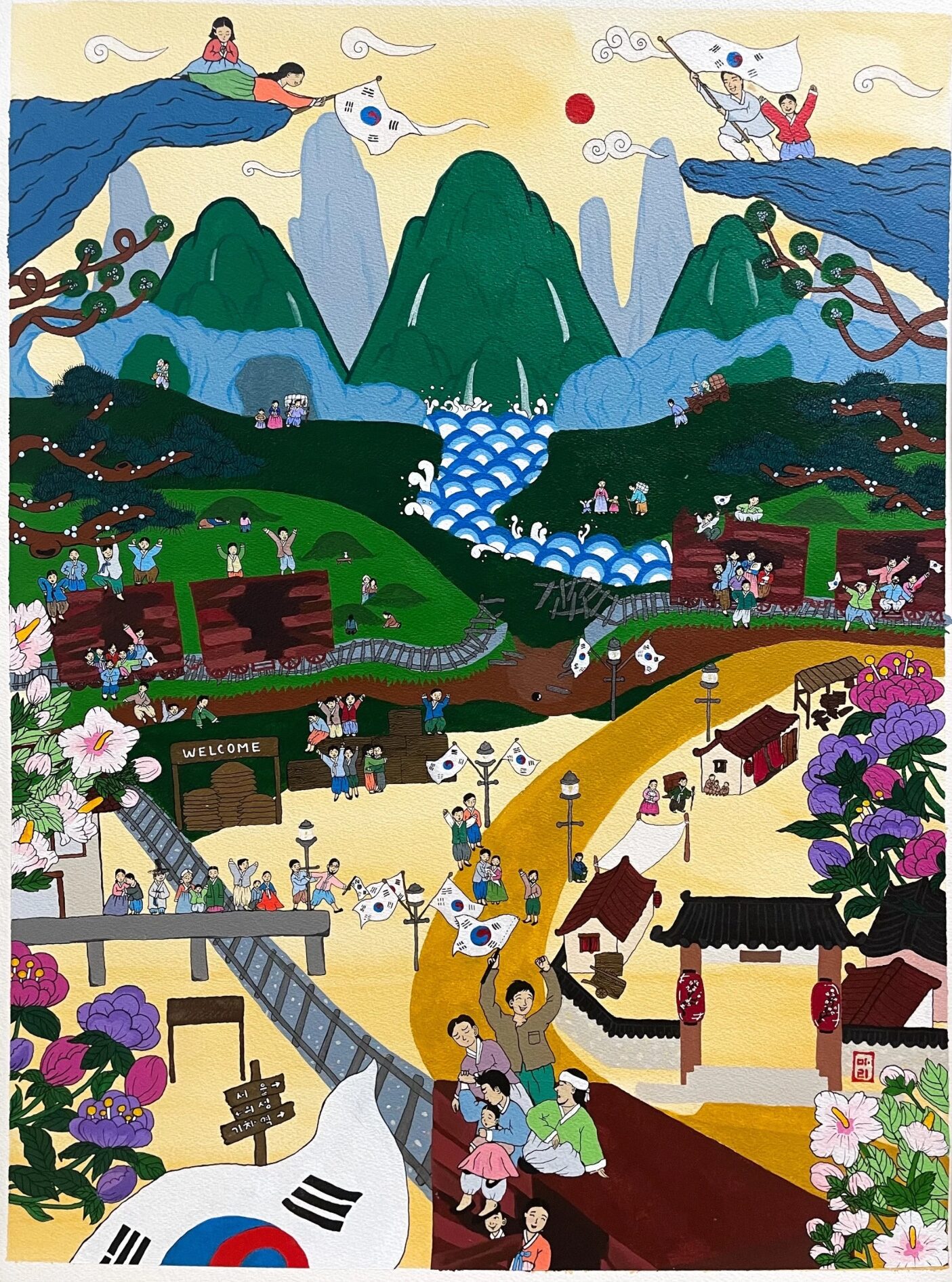 into headquarters for Communist officials. She and her family survived and escaped to Hong Kong. This work represents this experience and familial history while referencing political Chinese propaganda posters. It captures the struggles and journey of independence, hope, and freedom.
Joan Kim Suzuki (Plainview), Independence Day, 2025, Acrylic gouache and ink on paper.
Artist Statement: Inspired by her grandmother’s memories, Joan Kim Suzuki reflects on Korea’s liberation from Japanese colonial rule at the end of World War II. The moment followed the bombing of Hiroshima and carried a complex mix of devastation and relief. The artist’s grandmother recalled being lifted from despair by three young men who took the infant (Kim Suzuki’s father) she carried and helped her continue on. This work captures the duality of that time—grief for the losses of war and gratitude for the hope of freedom.